A gift guide has to do different things at different points of the holiday season. In late October there is nothing on sale yet, at the end of November it carries the Black Friday and Cyber Monday promotions, in mid-December it has to tell people whether their order will arrive in time, and in January it welcomes the people who received the gifts. For the rest of the year it stays on the site with very little to do until the next season.
This article follows the guide through those six phases and, for each one, looks at what the page should show and why. To keep the timing concrete we use the 2026 calendar, with Thanksgiving on November 26 and Christmas on a Friday, but the same sequence comes back every year and the reasoning holds whatever the dates. Planning it now is worth the effort: Adobe expects a record $275.1 billion in US online spending across November and December 2026, up 6.7% on last year.
Why a Gift Guide Exists
Before following the page through the season, it helps to be clear about the problem it solves. Nielsen Norman Group counts gift buyers among one-time shoppers, who often don’t know the site or even the products it sells, and who rely on clear navigation to reach anything useful.
Many of them are still undecided well into the season: in NRF’s December 2025 survey, a third of the shoppers who still had more than half of their list to buy said they were still working out what to get. Indecision has a cost, too, since in Accenture’s 2025 holiday survey 85% of shoppers said frustration or indecision makes them likely to abandon their cart altogether.
The gift guide’s first job is to shorten that path. It gives the visitor entry points built around the person they are buying for, so that someone looking for a present for their wife goes straight to the women’s collection and someone shopping for their son goes straight to kids. The earlier that route appears, the better: Baymard’s usability testing found that some users start thinking about gift options on the product page, and some even before they reach the site.
Structurally, the guide works as a showcase. It selects and frames a part of the catalog and sends the visitor to the product listing pages, and those PLPs are where the more specific rules live, such as filters by discount percentage or category badges on the product cards. The rest of this article follows how that showcase, and the PLPs behind it, change from one phase to the next.
Phase 1: Announcing the Guide, October 26 to November 19
The first version of the guide goes live before anything is on sale. In this phase its job is to collect sign-ups, with one of two promises attached: being told the moment the sale starts, or getting into an early-access sale one week before everyone else.
That timing follows how people shop for the holidays. In NRF’s 2025 holiday survey, 42% of shoppers planned to start browsing and buying before November, mostly to spread their budget (54%) or to avoid last-minute stress (41%), while 63% planned to do most of their shopping over Thanksgiving weekend. A guide that is live in late October serves both groups: early browsers find ideas, and the people waiting for the deals get a reason to leave their email address. Shoppers also say they want to hear early, as 88% of respondents to Optimove’s 2025 holiday survey said they prefer to receive holiday offers early from the retailers they like.
One public example of this phase at work comes from Klaviyo: the luxury makeup brand Patrick Ta Beauty promoted its loyalty perks and early access to its holiday promotions, and saw email sign-ups grow 41% period over period in the week before Black Friday.
Publishing early also has a search benefit. Google’s guidance for Black Friday pages is to create the landing page well before the sale so that it can be discovered and indexed in time, and to link to it from the homepage.
Phase 2: Early Access for Subscribers, November 20 to 26
A week before Black Friday, the sign-ups collected in phase 1 come into play. The early-access sale opens and the same gift guide starts showing two versions: visitors who haven’t subscribed still see the phase 1 page with its sign-up form, while subscribers see the early prices and can buy straight away.
Klaviyo’s case study on the activewear brand POPFLEX describes this sequence: subscribers were invited to sign up for a password-protected early-access sale, after which the Black Friday discounts went public, and the brand reports that the opening day of the sale was its best ever.
On Shopify, both versions can live on the same URL. When a customer is logged in, the theme can read the tags on their account through Liquid and display content reserved for a specific group of customers. The price shown and the price charged are handled separately, because Liquid can change the price displayed on the storefront but does not change what the customer pays at checkout, so the early-access price has to come from a real discount, and Shopify discounts can be limited to specific customer segments. One detail to plan for: at the time of writing, segment membership can’t be read in Liquid, and the usual workaround is to tag the segment’s customers with Shopify Flow.
Phase 3: Black Friday and Cyber Monday, November 27 to 30
When the early-access week ends, the discounts go public and the guide opens to everyone. The entry points built in October stay where they are, and a new one appears next to them: shopping by discount percentage. Inside the PLPs the guide links to, the rules change accordingly, with filters by discount percentage and badges on the product cards.
These days concentrate a large share of the season’s online spending. Adobe forecasts $47.5 billion for the five days from Thanksgiving to Cyber Monday, which in 2026 run from November 26 to November 30, equal to 17.3% of the whole season, with Cyber Monday the biggest single day at $15.1 billion and Black Friday at $12.9 billion.
Baymard’s research supports giving discount seekers a direct route. Its guidelines recommend always offering a sale or deals filter, placed in the main filter interface, and building the sales list as a filter applied to each existing category, so that discounted items in women’s, for example, are reached from within women’s. On the product cards, Baymard’s testing found that showing the discount both as an amount and as a percentage works best.
Urgency Cues
These days are also where urgency cues belong: a countdown to the end of the sale running across the site, badges that flag limited stock, and messages showing how many people have recently bought a product. They suit Black Friday and Cyber Monday in particular, when the buying frenzy is at its peak, and NRF expected a record 186.9 million people to shop between Thanksgiving and Cyber Monday in 2025. Researchers from Princeton and the University of Chicago explain the mechanism: urgency plays on the scarcity bias, making offers feel more desirable and inaction feel like a lost saving, and the fear of missing out grows stronger when countdowns are combined with scarcity and social proof messages.
The evidence that these cues move sales comes with a condition. Research summarized by UCLA Anderson Review finds that scarcity messages in flash sales do make shoppers buy more often, but a study of an online department store showed the effect depends on the product: low-stock messages helped slower-selling, aggressively priced items, while in other cases a low count can signal that a product is obsolete or unwanted. Black Friday promotions are built around aggressively priced products, which is why the cues fit this phase in particular.
What keeps them on the right side of the line is that every cue has to be true. The FTC’s 2022 staff report on dark patterns lists baseless countdown timers, false low-stock messages and false activity messages among the deceptive designs it targets, and these are far from rare: a crawl of about 11,000 shopping sites found 157 deceptive countdown timers on 140 of them. The same cues are legitimate when they describe reality, meaning the stock really is low, the sale really ends at the time shown, or shoppers really are buying the product. In practice that means tying the countdown to the actual end of the promotion and connecting stock badges and purchase messages to live inventory and order data.
Phase 4: Shipping Cutoffs Before Christmas, December 1 to 24
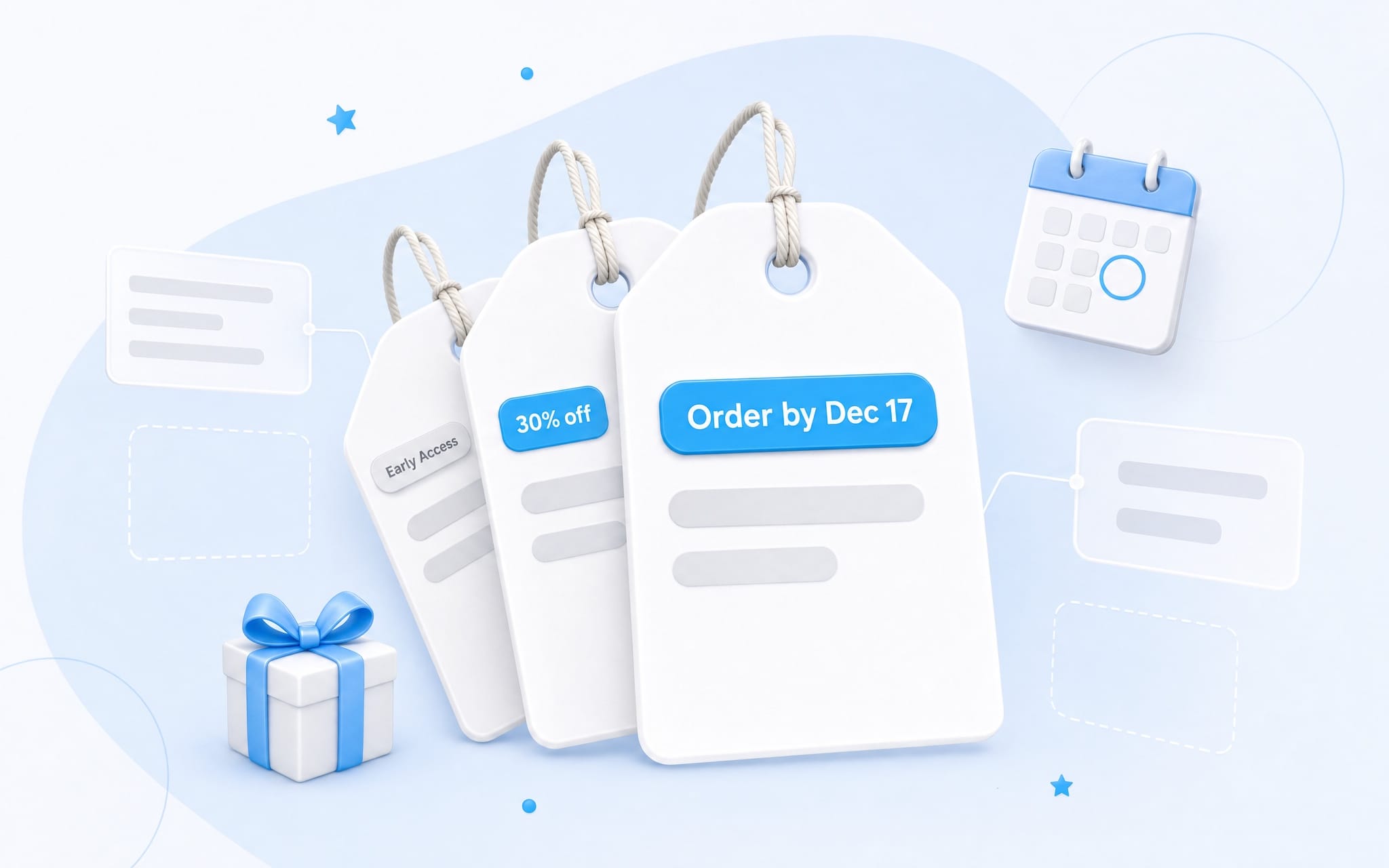
Once Cyber Monday is over, the guide’s message moves from price to time. Each product it shows should answer one question for the visitor: if I order today, will it arrive before Christmas? On the page, that becomes a plain statement in the form “order by X to receive it by Y”.
The dates come from the carriers and change every year. For 2026, USPS recommends sending by Thursday, December 17 with Ground Advantage, Friday, December 18 with Priority Mail and Saturday, December 19 with Priority Mail Express for delivery before December 25 in the contiguous US. A brand’s own order-by date sits earlier than the carrier’s send-by date, by as long as its warehouse needs to pick, pack and hand over the parcel. December 19 is also Super Saturday, the last Saturday before Christmas, when NRF expected a record 158.9 million people to shop in 2025.
There is still a lot of demand to serve in this window. In early December 2025 shoppers had completed, on average, about half (51%) of their holiday shopping, and online was the most common place they planned to finish it (46%). Shopify’s holiday advice includes displaying shipping cutoff dates prominently on the site, for instance with a banner.
Phase 5: Returns and New Gifts, December 26 to January 31
When the last parcels have been delivered, the guide changes again. From December 26 it has two jobs: pushing new gifts, and handling returns and exchanges.
Both follow how people shop after the holidays. In NRF’s December 2025 survey, 70% of consumers planned to shop in the week right after Christmas, mainly to take advantage of post-holiday sales (45%) and to use gift cards (26%), and in the 2024 edition of the same survey, 16% planned to use that week to return or exchange unwanted gifts.
The returns side is large. NRF and Happy Returns report that retailers expected 17% of 2025 holiday sales to be returned, and 37% of them planned to extend their return windows to manage the volume. For the gift guide this means a new selection for the people spending their gift cards, and a clear route to exchanges and returns.
Phase 6: The Rest of the Year, February to October
By February the post-holiday traffic has faded and the guide goes quiet. It disappears from the homepage and from the campaigns, but it stays published on the same URL until the next season begins.
Keeping it live is a search decision. Google recommends using one recurring URL for seasonal sales events, such as a sale address without the year in it, instead of creating a new URL for each edition. Yoast gives the same advice for gift guides in particular: keep the page up, stop linking to it after the holidays and link to it again when the next season comes, updating the year and the products instead of building a new page.
When October comes back, the guide starts the next phase 1 from an address that search engines have kept indexed for a full year, with every link it collected along the way.
What to Decide Before the Guide Goes Live
Put together, the six phases translate into a short list of decisions that are easier to make before the guide is published:
- which entry points the guide offers, and when shopping by discount is added to them;
- what the sign-up promises in phase 1, a notification when the sale starts or a week of early access;
- how subscribers are recognized in phase 2, and how their price reaches checkout;
- which filters, badges and urgency cues the guide and its PLPs switch on for Black Friday and Cyber Monday, and whether each cue is backed by real data;
- which order-by dates the page shows in December;
- what the page offers after Christmas, and what it says while it waits for the next season.
If your gift guide went live this week, how many of those decisions would it already reflect? If the answer is fewer than you’d like, perhaps we should have a chat.