

Like clockwork, Shopify has released Exponential, its Fall ‘26 Edition. With over 150 updates across agentic capabilities, operations, fulfillment, merchandising, and much more, simply scrolling through the landing page is enough to leave anyone cross-eyed.
If you’re looking for a recap of everything in Exponential, this is not it: point Claude at the Editions landing page and it will give you one. Instead, what we like to do with every new Edition is to step back from the trees and look at the forest, because with so many updates shipping at once, it’s hard to see where Shopify is headed.
Read from that angle, this Edition left us with three reflections:
- AI is Shopify’s Trojan horse. As we’ve already discussed, AI is how Shopify is taking over more and more of the relationship with the consumer.
- Canvas may be a bet on how organizations will change. Today, it suits small teams only. Tomorrow, it might suit larger ones that AI has reshaped. Or not.
- Shopify keeps shipping solutions before foundations. Brands at scale need infrastructure to build on, not another finished product competing with their existing stack.
Let’s dive into each one.
Agentic Commerce and Shopify’s Trojan Horse
For most of its history, Shopify has stayed out of sight. It gave merchants the tools to build their own store, and the relationship with the shopper belonged to the merchant. Shopify has also said many, many times that it has no interest in becoming a marketplace.
We could see some initial cracks in this approach with the Shop app and then shop.com (which Shopify bought from Market America for a reported, eye-watering $100M).
With AI, Shopify has accelerated this shift dramatically. It’s a trend we first noticed in our previous Editions analysis, and this Edition doubles down on it: a large share of it is aimed at consumers more than at merchants.
Without passing any moral judgment, we’ve been saying internally that agentic commerce is the perfect Trojan horse for Shopify to get closer to the end consumer, rather than having the merchant act as a middleman in that relationship.
It starts with the catalog. Until recently, the network Shopify exposed to agents was made of Shopify merchants. Now, like Amazon before it, Shopify also scrapes the web to include non-Shopify products in their Catalog API (checkout is still completed on the merchant’s own site).

Then there’s the matter of where that catalog ends up. The Shop side of this Edition reads more like a marketplace roadmap than it ever did:
- Universal checkout lets shoppers add products from different brands to one cart and complete all of their checkouts in one tap.
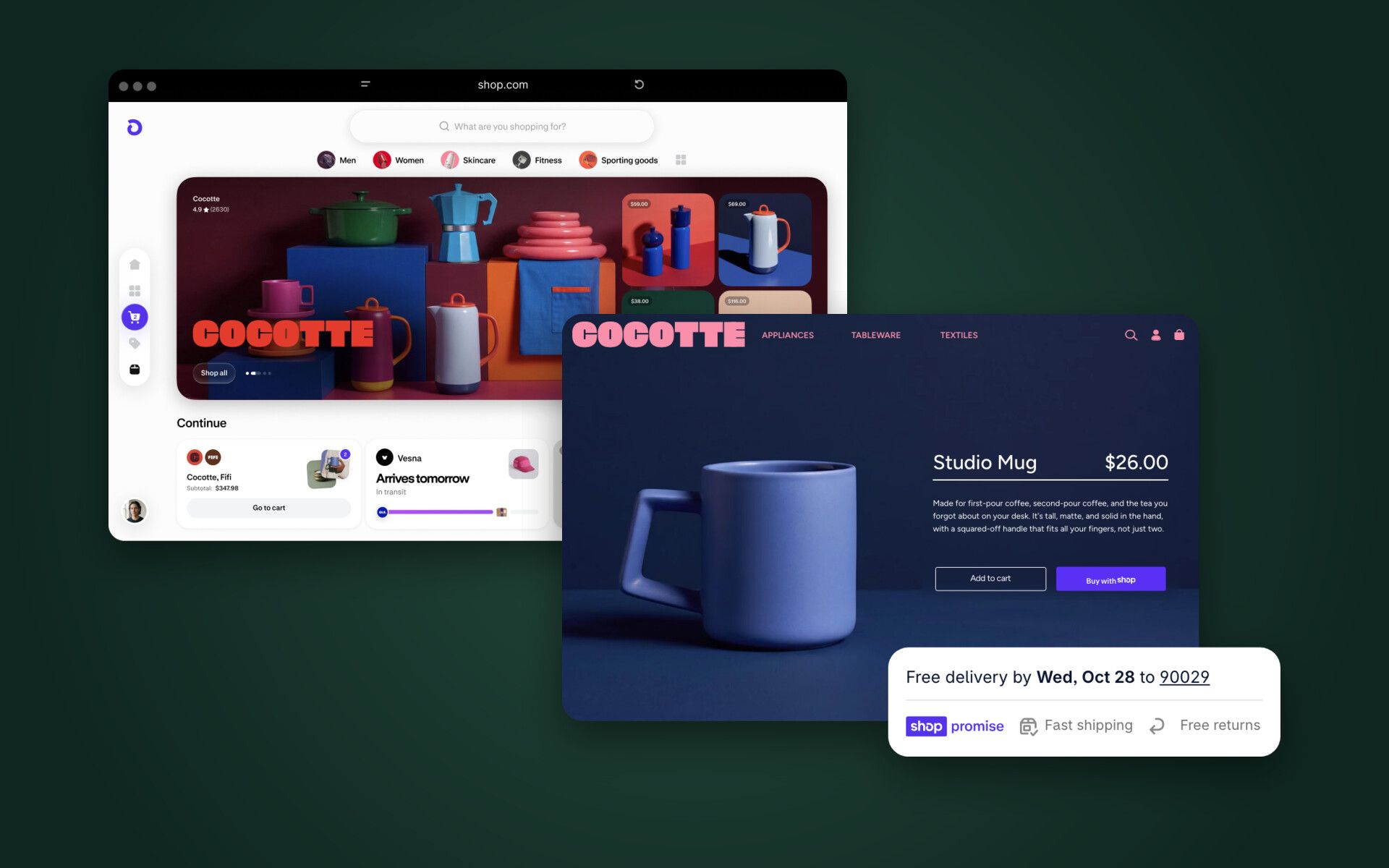
- The new shop.com promises curated content across the entire network. Today it still feels pretty unpolished, but the ambition is clearly to turn it into a proper shopping destination.
- Personalized search ranks results in Shop for signed-in shoppers on their browsing and purchase history.
- The Shop Promise badge, which rewards trusted delivery and returns, ranks products higher in Shop and in Shopify Catalog search.
- Shop MCP lets any app or agent search over a billion products, sign shoppers in with Shop, and check out from brands on or off Shopify with Shop Pay, for free and without an API key.
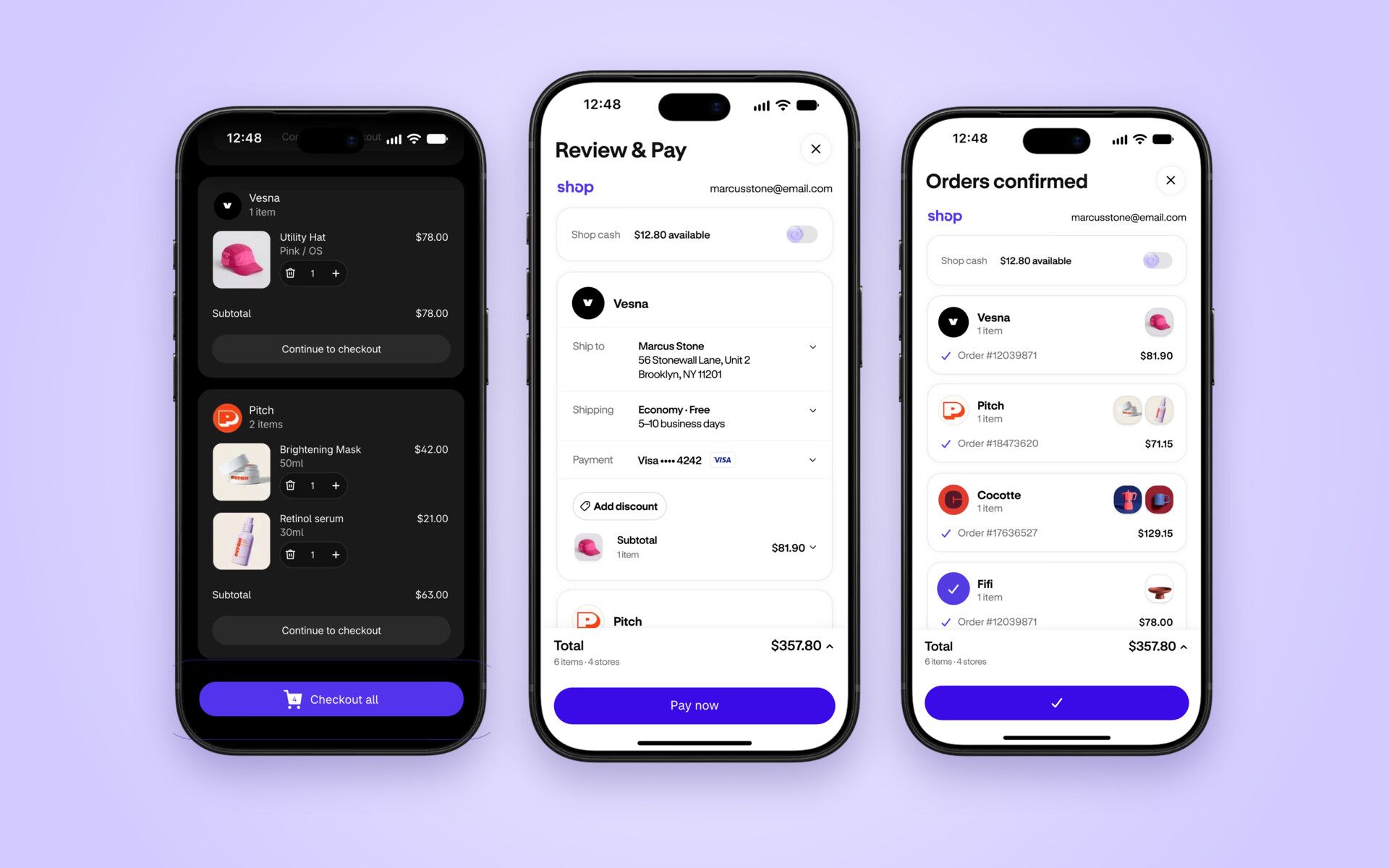
Meanwhile, more of what merchants build is flowing into Shop: your store’s branding and merchandising can now sync to your Shop landing page (in early access), and your Instagram content can become shoppable in the app. Put together, the catalog is turning from an asset each merchant owns into one that Shopify distributes: to its own app, to its own website, and to any agent that calls its MCP.
The Identity Play
The catalog is one half of a marketplace. The other half is knowing who the shopper is, and Shopify has been investing heavily in that, too.
Cross-brand identity solutions such as eComID have always suffered from a catch-22: few merchants adopt them because they don’t cover enough shoppers, and they don’t cover enough shoppers because few merchants adopt them.
Shopify never had that problem. It didn’t need merchants to opt into a separate identity product: it bundled Shop, its own identity graph, with its e-commerce platform. This Edition pushes Shop further as the one true way for consumers to identify themselves: not only on your Shopify store, but also in your Shopify apps (e.g., wish lists, reviews, loyalty), in your lead capture forms, and even on stores that aren’t on Shopify at all. Shoppers with a Shop account are now recognized whether they’re chatting with your online agent or paying at your counter, and their carts follow them across devices and visits.
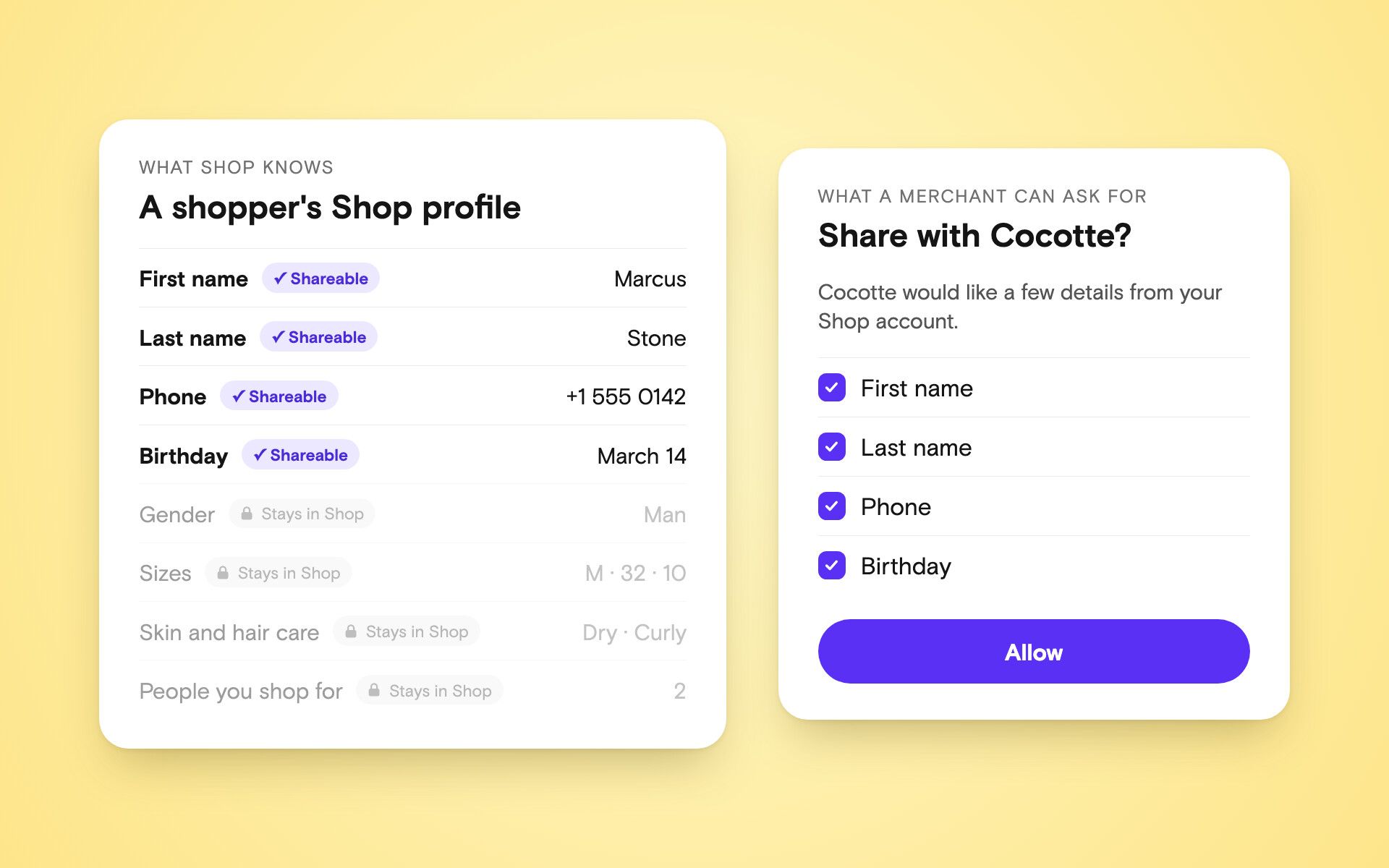
When we analyzed the last Edition, we wondered how much of this valuable shopper data Shopify would be willing to share with its merchants. This Edition gave us a preliminary answer: not that much. Through OAuth’s Rich Authorization Requests, an app or site that supports Shop sign-in can now ask Shop customers to share a few additional data points: first name, last name, phone, and birthday. (The documentation talks about storefronts, but doesn’t spell out whether stores hosted by Shopify are covered.)
That’s better than nothing, but miles away from useful. Even in zero-party data alone (i.e., what shoppers deliberately disclose), Shop knows much more than it lets them share: sign into the Shop app and you’ll see your profile also holds your gender, sizes, skin and hair care preferences, the people you shop for, and more. Then there’s everything Shopify has inferred from each consumer’s browsing and shopping history—which is probably what powers the new personalized search in Shop and the Global Catalog MCP, Shopify’s catalog search for agents, in the first place.
Why is Shopify keeping this data for itself? We doubt it’s technical: sharing eight data points per customer is not meaningfully harder than sharing four. And it’s hardly privacy, when customers are deliberately opting in to each request.
The simpler explanation is that Shopify considers its identity graph an asset to protect. That’s a reasonable choice, but merchants could benefit tremendously from this data. Think of how much effort the average $100M+ merchant puts into search and merchandising, and how much easier that job would be if merchandising apps could see each customer’s demographic and behavioral data across the entire Shopify network. We expect Shopify to find new ways to activate this data on its own surfaces long before it gives third parties unfettered access.
The last piece of any good marketplace is advertising, of course, and Shopify has been hard at work here too: Shop Campaigns are now available in more than 35 new markets, and promoted placements (in early access) pay developers of agentic experiences a commission on the sales they drive through the Catalog API: 0.3% from Shopify, and more on products in a merchant’s active Shop Campaign (for now, only on US purchases completed in Shop).
Canvas as a Bet on How Brands Will Work
If Shop is how Shopify uses AI to reach shoppers, Canvas is how it uses AI to make merchants faster. It also makes for a very shiny demo.
Canvas lets you design your entire store in one view. It’s in early access for select stores, and Shopify has announced it’s coming to ChatGPT, Claude, and other agents beyond Sidekick. It has caused real turmoil in the ecosystem: agencies and theme developers see it as another shot aimed at them; app developers complain that it doesn’t support their apps; merchants, for the most part, have been indifferent.
At Nebulab, we’re on the fence about it.
As it stands today, larger merchants can’t realistically use Canvas. The tool itself has a long way to go: it doesn’t support app blocks, app embeds, or third-party themes, and you can’t customize a theme for different markets. Once a theme has been edited in Canvas, it can no longer be opened in the theme editor, it stops receiving theme updates, and its files can’t be downloaded.
Even if those gaps closed, larger merchants need structure and clear handoffs. They have design, engineering, e-commerce, and merchandising teams; launches and promotional calendars, with theme changes scheduled well in advance; creative directors who gatekeep every major overhaul. They can’t afford to have individuals reshape the entire theme with no coordination, which is what every Canvas demo shows right now.
Does that mean, then, that Canvas will be relegated to the realm of SMBs? Not necessarily. From here, we see two possible directions.
The first is that it stays an SMB tool. Shopify has done this many times: build a simpler version of something for its smaller merchants, and leave specialized vendors to serve the larger ones.
The second is that Canvas is a long-term bet, partly on what AI will eventually be able to do, but more importantly on how AI will rewrite org structures, reporting lines, and decision-making.
It’s hard to imagine a large, complex brand giving its operators the autonomy to change so much, so deeply, all at once, but we wouldn’t bet against it. As AI makes production faster, we’re already seeing the bottlenecks shift to review and approval: for many orgs, efficiency is no longer a matter of capabilities, but of processes. As they embed AI deeper into their workflows, they may move from strict checks and balances to a system where everyone can move as quickly as they want while staying coherent with the brand and the broader strategy.
Shopify is already laying some groundwork here: Sidekick can now read Markdown files that teach it how your theme is built and remember your design preferences across conversations. Guidelines that an AI can follow are exactly what that kind of organization would need.
This may sound a bit woo woo, but parts of the industry are already getting there. See, for example, The New Fundamentals of Brand by Eugene Healey.
Now, whether Shopify is consciously pursuing this path is another matter entirely. While it has said that Canvas is not replacing the existing editor yet, it is more likely that it will wait and see who ends up adopting the new tool before committing to a direction.
Solutions First, Foundations Later
The third reflection is about what shoppers get once they’re on your store, and how Shopify chooses to deliver it: in this Edition, a storefront agent in Shopify Inbox and simulated shoppers in SimGym.
Shopify does ship infrastructure, and over the years it has given us plenty of building blocks we rely on. We’d just like more of it, and in a different order. Too often, Shopify ships a finished solution first, and that solution leaves little room around it for the merchant’s stack. Brands at scale always have a stack. Foundations would serve Shopify’s own solution, third-party providers, and that stack all at once.
Shopify Inbox is a good example. It now includes a storefront agent: shoppers get personalized recommendations, start checkout from the chat, and reach your staff when they need to. Shopify says customers signed in with Shop convert up to 1.5x better in these chats, and Shop’s context on each shopper is a real edge that standalone chatbot vendors can’t match. The problem is that most brands we work with already run several chatbots—for product discovery, for customer support, on the product page—each from a different app with its own interface and data. Inbox adds one more.
What we’d like is a chatbot layer. Shopify would provide one interface and the shared data underneath it, and apps would plug into it over MCP, configured from the admin. Shoppers would get one conversation, brands would manage one thing, and apps could focus on what they do best. Inbox would then be one solution built on top of that layer, not another widget competing with the rest. We’re not holding our breath, but it’s the version we’d bet on.
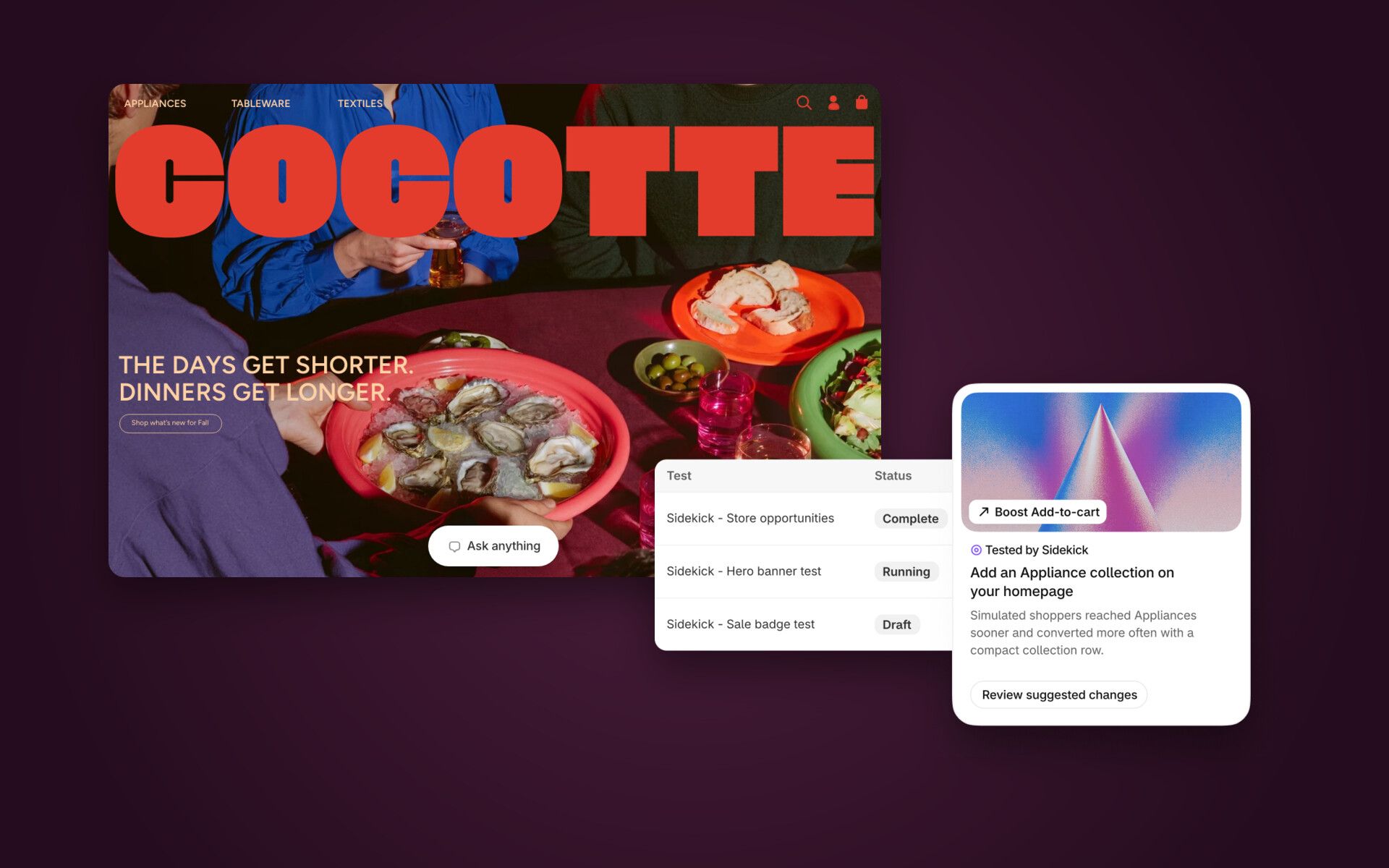
SimGym follows the same pattern. It runs simulated shoppers through your store, and this Edition lets you set a shopping goal for a simulation, while Sidekick uses SimGym to test the improvements it proposes. We said it in our Winter ‘26 recap and we’ll say it again: simulated shoppers are not a substitute for real ones.
To be fair, Shopify does offer real A/B testing: Rollouts now covers headless builds, Shopify POS, Google Shopping, and the Shop app. But it’s Shopify’s own tool, not infrastructure that testing providers can build on. What we’d like is exactly that: native ways for any provider to assign variants, expose results, and read performance. Everyone would benefit: vendors would get a first-class integration instead of workarounds; merchants would get one consistent setup, whichever tool they choose; Shopify would know which tests each merchant runs and how they perform, and could put that data to work in countless ways, both for that merchant and across the platform.
Shopify Wins Either Way
What’s striking about this Edition is how little Shopify’s strategy depends on agentic commerce taking off. Shopify is investing heavily in AI before anyone can point to its impact. But even if agents never become a major sales channel, the bet has already paid off elsewhere. Shop and shop.com put the Shopify name in front of consumers, the identity graph keeps growing, Shop Campaigns and promoted placements are the beginnings of an advertising business, and every merchant now has a reason to believe that leaving Shopify means falling behind. That’s an audience, a data asset, and a revenue stream that Shopify could never have built as a behind-the-scenes platform.
For merchants, the question is no longer whether Shopify will move closer to their shoppers. It’s how much of that relationship they’re willing to let it hold.
As always, if you need help sorting through what this Edition means for your business, let’s talk.